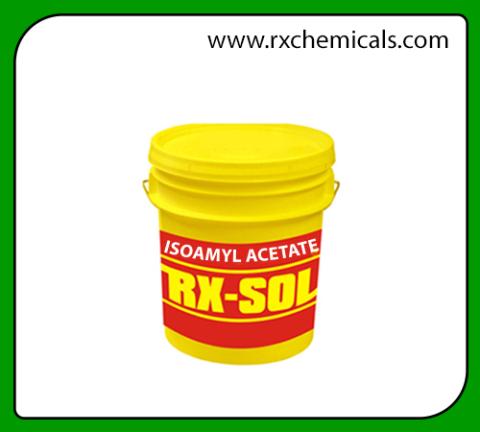
Product code: RXSOL-19-1324-025
- Usage unit
-
Ltr.
- Quantity per unit
-
25.00
Isoamyl Acetate is a colorless, oily liquid with a banana-like odor. It's an ester made from acetic acid and isoamyl alcohol. It's used as a solvent, in perfumes, and in artificial fruit flavorings
Application
It creates a strong, fruity banana or pear odor that is widely used to flavor foods, attract bees, and improve the smell of everything from perfumes to shoe polish. It is even used as a solvent for oil colors, lacquers, and resins; and, strangely enough, it can be used to test gas masks
Technical specifications
| PRODUCT NAME | : | ISOAMYLACETATE |
| CAS number | : | 123-92-2 |
| UN number | : | 1104 |
| Formula | : | CH3COOCH2CH2CH(CH3)2 |
| Odour | : | BANANA LIKE |
| Solubility in water | : | SLIGHTLY |
| Density | : | 0.867at 20 oC |
| Boiling point | : | 142 oC |
| Melting point | : | -78oC |
| Viscosity | : | 1.03 cp at 9oC |
| Flashpoint | : | 26 oC |
| Explosive limits | : | 1.0 – 10.0 Vol% |
| Vapour pressure | : | 5.3 mbar at 20 oC |
| Skin absorption/irritation | : | YES |
| TLV Country NL Year 1995 | : | 100 ppm 530 mg/m3 |
| Pollution category 1994 | : | C |
Procedure
This compound is typically used as a flavoring in sweets food, adding a fruity flavor.
Useful area
ISOAMYL ACETATE results banana or pear flavor, most commonly Used in manufacturing soft drinks, chewing gum, candies, mineral waters, and syrups. It's also used to give circus peanuts, Juicy Fruit, and pear drops a banana or pear flavor.
Tag identification
#IsoamylAcetate_Dubai
#IsoamylAcetate_Muscat
Supply locations
ISOAMYL ACETATE manufacturer supplier distributor in Mumbai, Kandla, Kolkata, Vizag, Chennai, India, Fujairah, Dubai UAE, Muscat Oman, Kenya Africa. Get the best quality of ISOAMYL ACETATE at a competitive price from us. We have ready stock of ISOAMYL ACETATE in India, UAE Gulf, Oman, Kenya Africa. Contact us for bulk as well as small orders.
Note
Natural occurrence. Isoamyl acetate occurs naturally in many plants, including apple, banana, coffee, grape, guava, lychee, papaya, peach, pomegranate, and tomato. It is also released by fermentation processes, including those used for making beer, sake, cognac, and whisky.